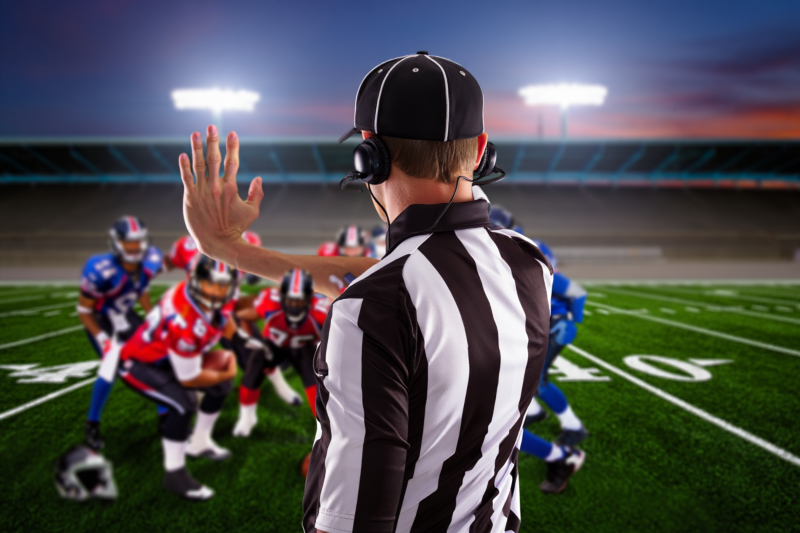
In the high-stakes, fast-paced world of American football, the role of NFL officials is crucial in maintaining the integrity and fairness of the game. Their decision-making process, often under intense scrutiny, ensures that every play adheres to the established rules, fostering a level playing field for all teams. This article delves into how NFL referees make penalty calls, the tools they use, and the principles guiding their actions to uphold fair play on the gridiron.
The Role of NFL Officials in Ensuring Fairness
NFL officials are the backbone of game integrity. They are tasked with monitoring the game closely, interpreting complex rules swiftly, and making critical calls that can influence the outcome of the game. Their primary responsibility is to enforce rules consistently and accurately, ensuring that neither team gains an unfair advantage.
Key Responsibilities of NFL Referees
- Monitoring gameplay for rule infractions
- Making real-time penalty calls
- Explaining decisions to players, coaches, and fans
- Reviewing plays via instant replay to ensure accuracy
- Managing game flow to prevent delays and maintain fairness
How Do NFL Officials Make Penalty Calls?
Making correct penalty calls amidst the chaos of a game is a complex process. NFL officials rely on a combination of training, experience, and on-field judgment, supported by technology, to ensure their decisions are fair and precise.
1. Pre-Game Preparation and Rule Knowledge
Referees undergo rigorous training focused on the current season’s rulebook. They study play scenarios, common infractions, and updates to ensure they are prepared for various situations that may arise during the game.
2. Real-Time Observation
During the game, officials position themselves strategically to observe different angles and aspects of each play. They focus on key areas such as the line of scrimmage, secondary coverage, and end zones.
3. Use of Technology and Instant Replay
The NFL employs advanced technology to assist officials:
- Instant Replay Reviews: Allows referees to review questionable calls to determine if a penalty or ruling should be overturned.
- Broadcast Camera Angles: Help officials see plays from multiple perspectives, reducing errors.
- Communication Systems: Referees communicate with each other and with the booth for quick consultations.
4. Signal and Communication
Referees use standardized signals to communicate calls on the field. Clear signaling ensures transparency and understanding among players, coaches, and viewers.
5. Decision-Making Process
When an infraction is suspected:
- The official signals the perceived foul.
- They communicate with fellow officials.
- The team initiates review if necessary (e.g., booth reviews for certain infractions).
- A final decision is made, which is then communicated to players and coaches.
Principles Behind Penalty Enforcement
NFL officials follow core principles to uphold fair play:
- Impartiality: Decisions are based solely on the rules and evidence, free from bias.
- Consistency: Applying the same standards across all games and situations.
- Accuracy: Utilizing all available information to make the correct call.
- Transparency: Clearly communicating decisions to all stakeholders.
Common Types of Penalties and How Officials Decide
Here’s a quick overview of frequent penalties and their enforcement:
| Penalty | Typical Causes | Official Decision Process |
| Offside | Player crosses the line of scrimmage early | Spot foul, signal, and penalize a five-yard penalty |
| Holding | Grab or impede an opponent illegally | Observe from multiple angles, signal, and mark the spot |
| Pass Interference | Contact before the ball arrives or illegal obstruction | Use replay to assess if contact was early or illegal |
| Personal Foul | Unnecessary roughness, helmet hits, or unsportsmanlike conduct | Review via replay if necessary, then penalize accordingly |
How NFL Officials Prevent and Minimize Errors
Despite complex procedures, mistakes can still occur. The NFL’s approach to minimizing errors includes:
- Continuous training and updates on rules
- Utilizing multiple angles in replay technology
- Post-game reviews and accountability measures
- Ongoing evaluation of officials’ performance
Frequently Asked Questions
How do NFL officials decide whether to flag a play for a penalty?
Officials base their decision on rules, real-time observation, and sometimes review footage. They prioritize clear evidence, and if in doubt, they may choose not to flag to avoid unjust penalties.
Can officials change their decision after the game?
Yes, post-game reviews can lead to overturned decisions in special circumstances, correction of errors, and adjustments for future officiating.
What training do NFL referees undergo?
Referees participate in extensive pre-season training, classroom rule reviews, on-field drills, and continuous education throughout the season to hone their skills.
NFL officials are highly trained professionals dedicated to ensuring fairness in every game. Through a combination of rule familiarity, strategic positioning, technological support, and principled decision-making, they enforce penalties accurately and impartially. This rigorous process not only maintains the integrity of football but also enhances fans’ trust and the sport’s credibility.
By understanding how NFL referees enforce rules, fans and analysts can better appreciate the precision and dedication involved in maintaining fair play on America’s football fields. Whether reviewing contentious calls or supporting their professionalism, one thing is clear: NFL officials work tirelessly to uphold the spirit of the game.